
I was recently asked if I had any training resources with simple examples of clean loops in dog training. I didn’t, which got me thinking exactly what makes a clean loop and how I would help students with this concept.
The great thing is it’s not limited to the basics of a sit or down. I’m using it with one of my dogs to help him have positive experiences in the world where he faces many situations that trigger emotional responses. Utilising the clean loop approach ensures I set him up for success as much as possible!
The are many possibilities where you can apply this practice. So, let’s look at exactly what clean loop dog training is, how we can apply it, and how to address some of the more common hiccups along the way. I hope you find this a useful explanation and guide.
What is clean loop dog training?
🐾 Clean loop dog training is a method that emphasizes clarity, consistency, and precision in each cycle of training. The idea is to create a smooth, uninterrupted sequence where the dog clearly understands what’s expected and responds without confusion or hesitation.
🔄 What Makes a Loop “Clean”?
A clean loop typically includes:
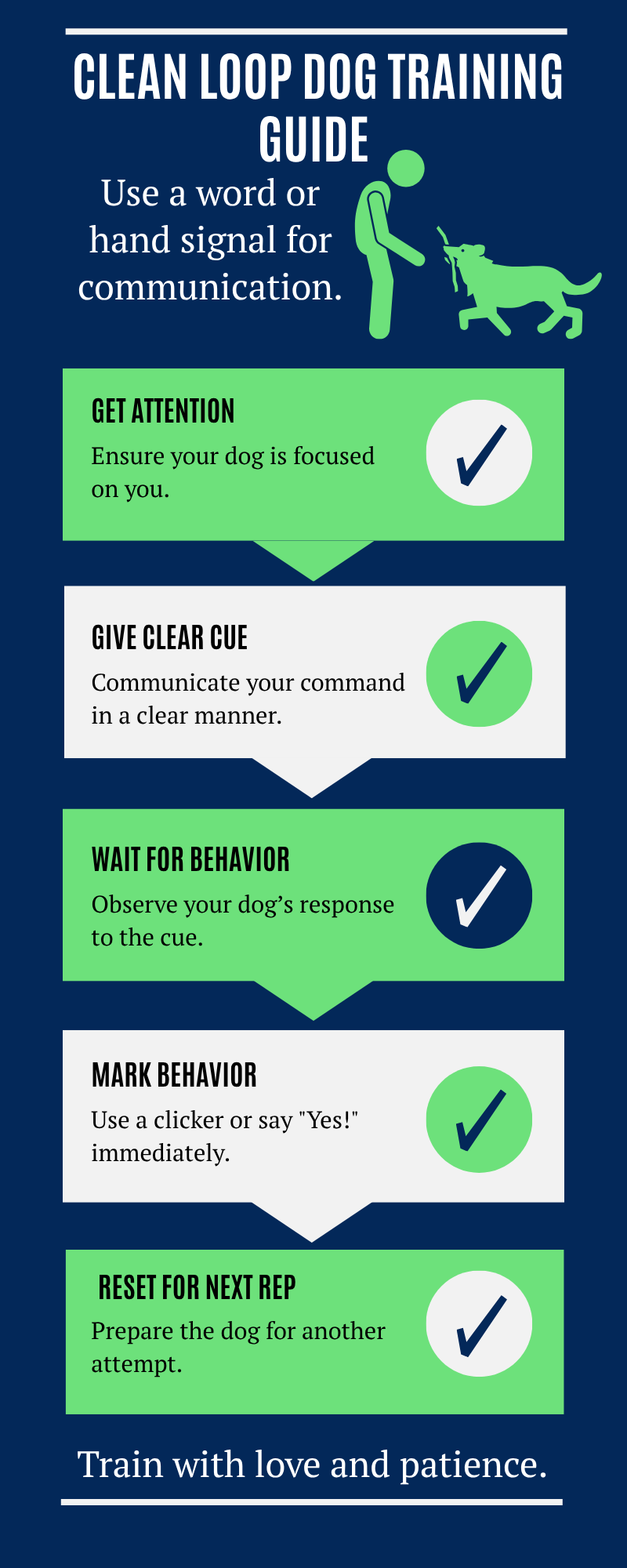
- Cue: The trainer gives a clear signal or command.
- Behaviour: The dog performs the desired action promptly.
- Marker: A click or verbal cue (like “yes!”) marks the correct behaviour.
- Reinforcement: The dog receives a reward (treat, toy, praise).
- Reset: The dog returns to a neutral position, ready for the next cue.
For the loop to be considered “clean,” there should be:
- No extra or unintended behaviours (e.g. sniffing, wandering).
- Minimal delay between cue and response.
- Smooth transitions between each step.
🧠 Why It Matters
Clean loops help:
- Build strong communication between dog and trainer.
- Prevent confusion or frustration.
- Make training more efficient and enjoyable for both parties.
If a loop becomes messy—say, the dog hesitates or adds unrelated behaviours—it’s a sign to reassess the training plan. Maybe the cue isn’t clear, or the dog needs more practice at a simpler level.
Here's a clear, step-by-step example of a clean loop training session to teach a dog to “sit” using positive reinforcement:
🪄 Step-by-Step: Teaching "Sit" with a Clean Loop
- Get Ready
- Have your treats in a pouch or hand.
- Be in a quiet space with minimal distractions.
- Your dog should be standing or walking nearby.
- Cue the Behaviour
- Say the cue clearly: “Sit.”
- Use a hand signal if you’ve introduced one.
- Dog Responds
- Ideally, your dog sits promptly.
- If not, wait a moment (a few seconds max). If they don’t respond, don’t repeat the cue—just calmly reset (see step 6).
- Mark the Moment
- As soon as the dog’s bottom hits the ground, use a marker:
- Click with a clicker
- Or say “Yes!” in a cheerful tone
- Reinforce
- Immediately give a treat or reward.
- Make the reward high value (especially in early training).
- Reset for Next Loop
- Toss a treat a few steps away to reset their position.
- Let the dog come back and re-engage.
- Repeat the process from Step 2.
✅ What Keeps the Loop “Clean”
- Don’t repeat commands.
- Always mark and reward promptly.
- Keep transitions smooth and distraction-free.
- End on a good note if the loop starts getting messy.
How do I handle common problems during clean loop training?
Great question—because even the most well-intentioned training plans hit a few bumps. Let’s look at the most common clean loop disruptions and how to handle them gracefully:
🐶 Common Issues & Fixes in Clean Loop Training
1. Dog Doesn’t Respond to Cue
- Why it happens: Cue isn't learned, distractions, or lack of motivation.
- Fix:
- Reassess if the dog truly understands the cue.
- Reduce distractions or move to a quieter setting.
- Use a higher-value reward to boost engagement.
- Go back a step in the training to rebuild the behaviour.
2. Dog Offers Extra Behaviours
- Why it happens: Confusion, overexcitement, or past reinforcement of random actions.
- Fix:
- Stay still and quiet—avoid reinforcing anything unintended.
- Use a clear marker only when the correct behaviour happens.
- Reset the dog’s position before re-cueing.
- Avoid giving cues in rapid succession.
3. Late Marking
- Why it matters: Delays can confuse the dog about what exactly earned the reward.
- Fix:
- Practice your timing with a friend or mirror.
- Mark the instant the correct behaviour happens—then deliver the treat right after.
4. Messy Reset Between Repetitions
- Why it happens: Dog wanders, gets distracted, or doesn’t return to neutral position.
- Fix:
- Toss the treat purposefully to reset position.
- Keep the loop flowing by keeping sessions short and upbeat.
- Use a recall cue if needed to bring them back into place.
5. Trainer Repeats the Cue
- Why it hurts: Repeating cues teaches the dog to wait until the second or third time.
- Fix:
- Give the cue once, wait briefly.
- If no response, calmly reset and try again.
- Reinforce only when the cue is followed on the first try.
👟 Training Tip: If your loop starts feeling messy or frustrating, it’s totally okay to pause the session and try again later. Training isn’t a race—it’s a relationship.
What are signs my dog is confused during clean loop training?
🐕 Great question—reading your dog’s signals is key to keeping training loops smooth and successful. Here are common signs your dog might be confused during clean loop training, plus what each might mean:
🧩 Signs of Confusion in Dogs During Training
1. Delayed Response or Hesitation
- Your dog pauses or stares after a cue.
- They may be unsure what’s being asked or need more repetitions to learn.
2. Offering Wrong or Multiple Behaviours
- They try “sit,” then “paw,” then “lie down”—cycling through options.
- Indicates guessing rather than confident understanding.
3. Looking Away or Wandering
- Disengaging or exploring the environment mid-loop.
- Suggests loss of focus, boredom, or uncertainty.
4. Lip Licking or Yawning
- Subtle stress signals often mistaken for being tired.
- Shows mild anxiety or confusion about the situation.
5. Pacing or Restlessness
- A dog might move around anxiously or struggle to hold position.
- Could mean the loop isn’t clear or the reward isn’t motivating enough.
6. Ignoring the Cue
- Not responding to a known cue after a brief pause.
- May indicate cognitive overload or environmental distraction.
🧠 What You Can Do
- Simplify the task: Break the behaviour into smaller steps and reward each success.
- Use a higher-value reward: Make it worth their while to engage.
- Take a short break: Sometimes clarity comes after a reset.
- Check your cue clarity: Ensure verbal and physical signals are consistent and distinct.
Training is a conversation—if your dog seems confused, it’s your cue to listen and adjust the dialogue.
Below are sample clean training loops for a few everyday dog behaviours. Each loop follows the cue → behaviour → marker → reinforcement → reset pattern for clarity and effectiveness:
🪑 1. Teaching "Sit"
Loop Steps:
- Cue: Say “Sit” with a hand signal.
- Behaviour: Dog sits down promptly.
- Marker: Say “Yes!” or click when their bottom touches the ground.
- Reinforcement: Give a treat immediately.
- Reset: Toss a treat a few steps away to get them standing again.
🚪 2. Teaching “Wait” at the Door
Loop Steps:
- Cue: Say “Wait” as you approach the door.
- Behaviour: Dog stays still without moving forward.
- Marker: Say “Yes!” once they hold position for a second or two.
- Reinforcement: Give a treat or open the door as a reward.
- Reset: Close the door again or walk away and re-approach.
🐾 3. Teaching Polite Leash Walking (“Let’s Go”)
Loop Steps:
- Cue: Say “Let’s go” and start walking.
- Behaviour: Dog walks by your side without pulling.
- Marker: Say “Yes!” or click when they stay beside you for a few steps.
- Reinforcement: Give a treat or praise while moving.
- Reset: Pause, take a few steps back, then restart the walk.
🦴 4. Teaching “Leave It”
Loop Steps:
- Cue: Say “Leave it” as you present an item (like a treat in your hand).
- Behaviour: Dog ignores the item or looks away.
- Marker: Say “Yes!” the instant they redirect attention.
- Reinforcement: Give a different treat or reward from another hand.
- Reset: Repeat the setup with the same item.
- The dog responding promptly
- A marker (clicker or verbal praise)
- A reward delivery (treat or toy)
- A reset, preparing for the next repetition
🎯 Cue → Response → Marker → Reward → Reset

Responses